
What If AI Isn’t Replacing Industrial Service Pros… But Removing the Work That Slows Them Down?
Industrial service businesses don’t have a technology problem.
They have a time leak problem.
Crews are solid. Technical work gets done. Customers are served. But behind the scenes, owners, ops managers, and service coordinators in AI for industrial service companies are buried in screen work that never stops.
Emails. Schedules. Service notes. Follow-ups. Reports. Invoices. Compliance logs.
That’s where AI actually belongs — not in the field, but in the operational layer that surrounds the work.
What is an AI agent in industrial services?
An AI agent is a system that observes service data, makes decisions, and takes action across tools to reduce administrative work, improve compliance, and support operations.
On This Page
- What AI Agents Mean for Industrial Services
- The 7 AI Agent Types
- How to Choose the Right Agent
- Pilot Framework
- Common Mistakes
- FAQs
What AI Agents Mean for Industrial Services
AI doesn’t replace field work — it replaces screen work.
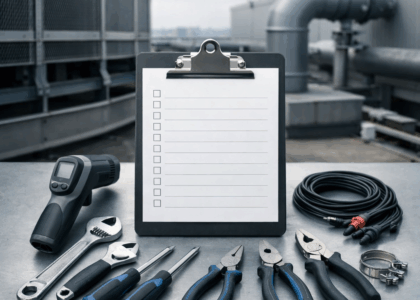
AI is not here to inspect cooling towers, test water chemistry, or service HVAC equipment. That’s skilled, physical work.
AI is here to handle everything around the work:
- Drafting service reports
- Summarizing technician notes
- Tracking follow-ups
- Organizing compliance documentation
- Scheduling and rescheduling
- Preparing proposals and renewals
If you want a structured starting point, many companies begin with a focused AI Discovery & Blueprint before deploying agents across operations.
The 7 AI Agent Types
AI agents go beyond basic automation. Unlike rule-based tools, they can interpret messy inputs, reason through next steps, and work across systems.
For a full breakdown of how agents work across service operations, see the AI agents overview for industrial services.
How to Choose the Right Agent
Before picking tools, ask three questions:
- What outcome are we buying back? (time, compliance accuracy, faster proposals)
- How much autonomy is safe? (internal drafts vs client-facing approvals)
- What’s the smallest version that proves ROI?
For regulated environments, especially water treatment and cooling tower service, most companies keep humans in the loop — particularly around Legionella compliance and documentation.
Quick gut-check: if an AI system could remove one recurring admin headache in the next 30 days, which one would actually change your week?
A Simple Pilot Framework That Works
Don’t roll out AI everywhere. Run a controlled pilot.
- Pick one workflow (reports, compliance reminders, proposals, renewals)
- Pick one metric (hours saved, errors reduced, follow-up speed)
- Assign one owner
- Run for 30–60 days
- Review failures and edge cases
- Decide: scale, refine, or sunset
Common Mistakes Industrial Service Companies Make
- Automating client communication too early
- Skipping approval steps in compliance workflows
- Buying tools instead of removing bottlenecks
- No feedback loop from technicians or ops staff
Who Should Not Use AI Agents Yet?
AI agents may not be the right starting point if:
- Your core workflows aren’t documented at all
- You don’t have consistent service data or notes
- No one owns operations or process improvement
- You’re trying to replace people instead of supporting them
In those cases, fixing process clarity comes before automation.
Final Takeaway
The companies winning with AI aren’t trying to become “AI companies.”
They’re removing one painful bottleneck at a time — reports, compliance logging, follow-ups, scheduling, renewals.
If an AI agent could remove one recurring bottleneck from your operation in the next 30 days, which process would you want gone first?
For a deeper operational perspective on how AI surfaces hidden inefficiencies, see how AI reveals hidden business patterns.
About This Page
This page is written for industrial service professionals — including water treatment, cooling tower, HVAC, and field service operators — who want to use AI in practical, operational ways.
The goal isn’t hype or theory. It’s to show how AI can remove administrative friction, reduce manual coordination, and help service teams run cleaner without replacing skilled field work.
About the Author
Vlad Gutenmakher is the founder of ThinkSky.ai and works with industrial service companies to design practical AI systems that improve operations without disrupting field work.
His focus is on removing administrative friction, automating coordination and follow-ups, and helping service businesses run cleaner through AI that supports — not replaces — experienced teams.
Frequently Asked Questions
How can AI help industrial service companies?
AI removes administrative and coordination work such as reporting, follow-ups, scheduling, and documentation so teams can focus on field execution.
Can AI replace technicians or service professionals?
No. AI supports operations around the work but does not replace skilled field labor.
What’s the safest way to use AI in service operations?
Human-in-the-loop systems where AI drafts and tracks, and humans review and approve final outputs.
What should industrial companies automate first with AI?
Recurring screen work that causes delays: reports, follow-ups, compliance logs, scheduling, and internal handoffs.
Why do large AI automation projects fail in service companies?
Because they try to automate everything instead of removing one key operational constraint first.
About This Page
This page is written for industrial service professionals — including water treatment, cooling tower, HVAC, and field service operators — who want to use AI in practical, operational ways.
The goal isn’t hype or theory. It’s to show how AI can remove administrative friction, reduce manual coordination, and help service teams run cleaner without replacing skilled field work.
About the Author
Vlad Gutenmakher is the founder of ThinkSky.ai and works with industrial service companies to design practical AI systems that improve operations without disrupting field work.
His focus is on removing administrative friction, automating coordination and follow-ups, and helping service businesses run cleaner through AI that supports — not replaces — experienced teams.